Showing posts with label Revenue Streams. Show all posts

Monday, December 24, 2007

How To Protect Yourself - Google's Clickable Area Change

I agree completely with what Google is trying to accomplish with the change. I think it is a step in the right direction for the industry as a whole in regards to quality.

That said... We were hit by the clickable area change as many other sites were from a revenue perspective. We've been testing a few different ad formats to see if can't make up some of the revenue we are losing. Previously we relied on the 336x280 as our primary ad block. This particular block seems to have lost the highest percentage of "clickable" area since it is so large but the titles are not that long in most cases, and the font sizes are quite small, making it extremely difficult for user to click the tiny title of the ad.

So we redesigned our page layout to utilize the wide skyscaper (160x600) and link units. Link units are unaffected by the change, and the wide skyscaper seems to do fairly well since the titles are often in a larger font and wrap two lines in some cases, giving more vertical click area, hence easier for a user to click on.

So what is our results so far? Here are some stats for one of our main pages:

  • October (before the clickable area change): 2.00% CTR

  • First week of December (post clickable area change): 1.02% CTR

  • Last 7 days (With new layout): 1.37% CTR

So can see we are climbing back but we are not there yet.

Overall we are still down about 25% on our CTR for all Adsense ads on our site.

Our saving grace was that we coincidentally recently added a few additional revenue streams, one being Kontera and the other being BurstMedia banners. The addition of both of these programs made up for the 25% loss of Adsense income, and pretty much left us where we were before the clickable area change.

So the moral of the story?
  1. Diversify your income streams.
  2. Experiment with other ad formats.
  3. Be patient. Give your changes time to really see how well they are performing.
  4. Try image ads, they are not affected by the change.
  5. Experiment with new ad placements.
If we hadn't, we'd be taking a pretty big income hit right now. Instead, we are holding steady.

Of course we try not to think of what we could be making if they hadn't made the clickable area change, but hey, that is the risk we all take by putting some of our eggs in another person's basket... ;-)

Sunday, October 21, 2007

How I Squeezed An Extra $3000/Month Out Of My Sites

For the past 6 months or so I had grown very complacent. I had been making decent money with my site(s), and thought I had reached a point where I had maximized my revenue for the traffic I was getting. I stopped reviewing the performance of my affiliate program, my PPC programs, my CPM programs. I grew too comfortable.

Then a few weeks back I read an interesting article (wish I could remember the name/link) where the author talked about always looking for new ways to monetize your sites. He was adamant on never growing too complacent. It kind of got me thinking about how I had grown so comfortable with my revenue streams and their performance. I had gotten to the point where I was turning away partners who wanted to run ads since I didn't want the headache and I thought everything was going so well, why mess up the mix.

I decided to make some changes.


Google Search Box
First order of business was to review what I already had. Was it doing the best it could? My first big find was with my site search. For years I had always had TWO search boxes. My own custom search script, and the Google Search box. I ran ads on my custom search results page, and so did Google. Looking at the stats, the Google search box was paying on average 4-5 times what my search script ads where paying. Looking at performance, the Google search box was finding things better on my site than my own search script. I decided to drop my search box.

This simple change boosted my Google search revenue by 4-5 times, adding an extra $1000/month to my bottom line. At the same time, it provided a better search tool for my site, and less confusion to my users on which search to use. And it took the load of search off my server and outsourced it to Google. A win-win.


In-Text Ads
Next up I re-visited some ad companies that had previously inquired about working with me. First up was Kontera. I had gone back and forth about them for a while last year. The program was kind of new, and the performance was subpar, so I passed on them. I decided it was time to give them another shot. I ran their ads for a few trial weeks. After the trial was over, I was not very impressed with the payouts. The ads were peforming decent, lots of clicks, but I wasn't making enough to make it worth it. Feedback from my users told me no one really minded them. My other revenue streams seemed unaffected by them. My only hold up was the payout. I felt for the clicks I was giving them, I should be making more. Well after pulling the ads, Kontera came back and offered a higher payout if we would reconsider. In the end we worked out a deal that made both parties happy, and I now had a new revenue steam tacking on an extra few thousand/month.


Low Impression Adsense Channels
I've always used Adsense channels to track performance of ads across my sites. But I never really paid much attention to most of my small, low impression channels. I spent most of my time optimizing the big hitting channels that produced most of my income. I finally decided to take a closer look at all my channels. By simply applying my same techniques used on my main channels, I found numerous opportunities to turn small revenue producing channels into medium revenue producing channels. After improving a few channels, I realized I was making an extra $10-$20/day. That equates to an extra $300-600 a month. Not bad. Kind of like finding money on the street... ;-)


Expenses
Next up I took a look at my expenses. I had been spending a lot of money on PPC ads with Adwords, Yahoo and Microsoft AdCenter, but I was not tracking the results very well. I was just assuming they were performing since I was getting the clicks. I built a tracking script and used it for all my ads. Come to find out, I was investing way too much in my ad campaigns for what I was getting in return! I ended up cutting my campaigns by 70%, saving me $500+/month. From my perspective that is like making an extra $500/month.


Newsletter
My last change involved my newsletter service. I was paying $50/month for a service that I barely used since I never had time to write-up newsletters. I decided to switch to Feedburner (free service) to host my newsletters, and I automated the newsletter process through RSS. Now I could send out interesting newsletters that aggregated news from around the web on a daily basis, and it was not costing me a dime! I cut $50/month off my expenses, and added a valuable newsletter service at the same time. Growing a newsletter subscriber list is an invaluable asset that can come in handy down the road when we need to diversify our traffic streams.


I hope you see from my examples above that it is worth re-evaluating your site's revenue streams and expenses on a regular basis. Just when I thought I couldn't do any better, I squeezed an extra $3,000+/month out of my site with no additional traffic.

Friday, March 16, 2007

Paid Reviews: Payperpost, Blogsvertiser, ReviewMe and Creamaid...

Paid reviews are getting a lot of press lately. I thought I would share my take on it. Paid reviews are basically a new way for companies to get the word out on their products or services. Some services, like Payperpost, require the blogger to post a "positive review" (crap in my opinion), while others like ReviewMe don't promise any positive spin. The company is paying for publicity. The idea is that the blogger's post/review will get read by their fan base, as well as picked up by search engines, etc.

Speaking from my own personal opinion on the situation, as a blogger myself, I have been hesitant to sign-up for such services as I am not sure how I feel about being paid to write a review.

I know it makes sense that my time should be worth something, but I'm just not sure how my readers would feel if/when they know that I'm being paid by the company to review the company/product.

Even with the "unbias no positive review guarantee" clause like ReviewMe has, it still seems taboo in the blogosphere to be a paid lacky for some company.

Just my opinion. Don't get me wrong... I love the idea of making additional money reviewing products and sites, but I just have not been sold on the validity of the model yet.

Monday, January 22, 2007

Running your own mini-hosting service with Plesk


I recently ordered a new server for my main site since traffic levels have started to creep slowly beyond the limits of my bargain basement dedicated server I'd been using for a few years now.

No holding back this time. I went all out and got a dual processor with 2 GB RAM and a 100 MB/s network connection. Should keep my site running smoothly for a few more years to come.

So on to Plesk. While ordering my server I accidentally requested Plesk be installed. I thought it was a advanced server admin tool much like Webmin. Come to find out it is a pretty cool full-featured hosting management tool. It lets you set any number of websites/accounts on your server with settings to control how much disk space each account gets, how muc memory they can use. They even get their own ftp access and webstats. All setup and managed from this Plesk software. Pretty cool stuff if I was ever going to get into doing some hosting (which I might down the road for sites I build as a consultant). But for my immediate needs, Plesk was too much so I ended up returning/removing it.

If you are looking to startup and manage your own hosting service on one of your servers with some free space, definitely check out Plesk... I think it cost around $15/month for a 30-site license. Also might be a good way to add some additional revenue if you have a under-utilized server...

Wednesday, November 01, 2006

Azoogle Update

Well I've finally been accepted into Azoogle after weeks of confirming my identity. I seriously think I had more trouble getting into Azoogle than I did getting a U.S. passport.

So my first few days of experimenting with the program have not been very successful. I ran a few programs in a highly visible section of my site. I thought I would just try some ROS (run of the site) ads. No user targeting for specific products. Well day one was not too shabby in regards to click-throughs. I had about 75 clicks for a particular product that I thought most my users would like. Well I received ZERO conversions from these 75 clicks. That is not good...=)

I know better than to waste my time on ROS advertising, but still I always try it out because I get lazy. To make money with any of these programs you have to target, target and target some more! This above test is a perfect example of what not to do. Don't just throw your ads up on the site and wait for the money to roll in. Do your homework up front. What are your users looking for? Perhaps you have 250 users a day looking for and finding a page on your site about VOIP. Well that page would be a great place to market any VOIP related products. You get the point.

By finding these gem pages throughout your site, you open the door to utilizing multiple affiliate products at the same time, in a highly targeted, and hopefully more lucrative way. Trick is to have some good webstats software. And then study the data until you go blurry in the eyes.

Then of course you test as many niches as you can until you find one that sticks and pays. Once you find those gems, re-direct your attention to growing that program and that content on your site.

Tuesday, October 17, 2006

Azoogle Affiliate Program

I've heard great things about the Azoogle affiliate program. It comes highly recommended from Shoemoney, so I figured it was worth checking out. I've heard they have some of the most generous payouts in the business.

So far my experience has been that they are very picky about who they approve, which I think is a good thing. I've been going back and forth with their reps for a week via e-mail to try and prove I own the domain I am applying with.

As it stands now, they want me to send a screen shot of a receipt showing my purchase/renewal of my domain. Not sure I can dig that up. If I ever get accepted, I'll be sure to post a follow-up. I'm very interested to see how well this program works. The more revenue streams the better!

Friday, October 13, 2006

Adding Revenue Streams

The Adsense program revolutionized online advertising and provided enough revenue to help grow my site to the next level. But as in any business, keeping all your eggs in one basket is risky. If I was going to someday make a living off my sites, I needed to figure out other ways to make money.

I had tried many of the generic affiliate shops in the past: Amazon, eBay, Commission Junction, etc. They all had one thing in common that I did not like... They were too big to care about a small publisher like me.

Then one day I received an e-mail from a company. They offered their own in-house affiliate program and wanted to invite me to join. They seemed to know a lot about my site and wanted to work together. We were able to setup a completely custom integration with their products into our site. However after a few months, and no sales it looked as though we had hit another dead end. Then one day, out of the blue, I received a check in the mail. It was only for about $60, but it was a check! I had earned my first commission!

I realized this was a legitimate program that paid out. I put all my efforts for the next month into providing more exposure for their products. The more work I did, the more I started to make. My earnings-per-click started climbing as I focused on targeting the products to users that were actually looking for something similar. Over the next year I would double my overall monthly revenue because of this new program.

From then on I learned to only focus my time and energy on affiliate partners, not affiliate programs. I only would only work with a program that had an actual person I could talk to, and only programs that had in-house affiliate management systems. If they gave me a link to signup and it redirected to Commission Junction, I would simply reply "not interested". I learned that too many middlemen is not good business, or at least not good for my small business.

Next up... Banned from Yahoo...

Thursday, October 12, 2006

The Emergence of Adsense (2003)


The new hands-free, community run design was progressing very well. I discovered that the site was much more useful to folks when they could get help from the community as a whole, rather than just me in the background trying to fulfill various services. The more regular users we had, the more useful the site became. It was a growing, dynamic community that was helping push the design of the site. I would get suggestions almost weekly for new features. Power-users were the most helpful. They were on the site more than I was, and had countless recommendations for improvements. In a sense, the community was building the site up for itself.

In the past, most website advertising had been in the form of banner ads. I tried them for a few years but never made more than a few cents a day here and there. I had also tried programs like Amazon.com and Commission Junction to try and sell products through their affiliate programs. But these programs required a lot work to keep your site and links up-to-date. Plus I just wasn't making any money earning a 5% commission here and there. My site was content driven. It was more of a research/community tool. It was not an ideal place to sell products.

It was around this time I read an interesting article about a new way for websites to earn revenue through contextual advertising. It was called Google Adsense. I have always been a huge fan of Google, so I thought why not try it out?

So one night I signed up and added the code to a few pages on my site. Interestingly, it generated ads that were related to the page, without me having to do any maintenance. What a great concept, and it fit perfectly with my low-maintenance design.

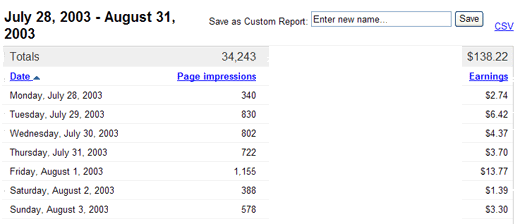
The next morning I woke up and thought I would check out how well this new revenue program really worked. I logged in an saw $2.74 in my account. Now this may seem like a small amount, but to me, it was revenue!


I continued to tweak my ad placements over the next few weeks. When my first full month was over, I had earned $138.22! I had my first official revenue stream.

Next up... Getting more traffic...